
First published on: Tue Jul 07 2009 23:51:20 GMT+0800

It has been a long time since I last blogged on my site. Back then I made a promise to myself to get involved in a blogging site that actually requires me to pay money to host the site as I’m a strong believer in ROI (i.e. blog more to justify the monthly fees!). It is not surprising, however, to have the realities of family and working life dictating how much time I can set aside to develop an editorial piece which is worthy to be published in my blog. After all, I am determined to document my personal observations on digital media so that it serves as a journal of my journey in this exciting medium.
It is perhaps fitting that the topic of interest in my observation today is on the realities of social media marketing for businesses today. Running a Google search on this subject will give you 234,000,000 pages in 0.23 seconds. As the number suggests, it’s no longer an emerging tool. It is a tool that needs to be taken seriously by the community.
Arguably, it is no longer surprising to hear of a fellow online user having a Facebook account. The service is not only accessible on the PC/laptop/Netbook, but is also on major mobile platforms such as the iPhone, Symbian handsets such as the Nokia N79 and even on the Blackberry.

In fact, Facebook is one of the very, very few Blackberry applications that is certified by RIM to have the clearance needed to be installed on any Blackberry device, despite the high enterprise security features associated with such business-oriented devices.
Indeed, Facebook has transformed the social media scene in the maturing Web 2.0 online world. You can even get a specific URL for yourself now that personalize your Facebook URL in the online world (though I still curse my slowness in getting my personal vanity URL from the site). Under this backdrop, we now see the number of unique visitors to Facebook have exceeded MySpace in November last year, with a staggering 113 million unique visitors in May 2009 alone.

Clearly, social media is no longer a medium used exclusively by tech geeks or net-savvy Generation Y individuals. In fact, Facebook is now used by a broader spectrum of users across various demographic groups. As the graph below illustrates, the site is beginning to see a more broad based participation, signally that such sites are evolving into a mainstream communication channel.

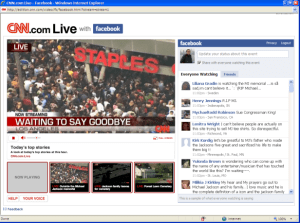
It is perhaps not surprising that many businesses are trying to get into the social media space in the hope that this will be the next alternative marketing channel. After all, Nielsen Online suggested in a March 2009 report that social networks and blogs are now the fourth most popular online activity, and ominously ahead of email which is the incumbent communication protocol since the evolution of the Internet. These sites collectively host online member communities which are visited by 67% of the global online population. In particular, Hitwise reported that Facebook users spend close to 19 minutes on the social networking site, representing the period where companies on these social networking platforms can potentially reach out to. This is probably one of the main reasons why established media channels such as CNN chose to integrate Facebook in their online programming such as the recent live telecast of Michael Jackson’s memorial in Los Angeles.
Clearly, this rising number represents the size of the target audience which companies seek to engage and establish an online relationship with. Assuming that such relationships are positive, the company would have created a parallel communication channel online to engage and build brand equity with these online users.
Invariably, questions will be asked on the sustainability of these social networking sites and virtual worlds that companies are presumably clamoring to establish their presence in them. Indeed, one of the pioneers in social networking, MySpace, had to retrench many of their global staff strength as they seek to compete with the rising popularity of Facebook.
But how do companies really do business on these social media sites? Is it simply the case of setting up an account or a page in Facebook, with the belief that it will be populated naturally by the more than 200 million users on this social media site?

I would argue that businesses should not use the size of these online communities as the motivating force to establish their online presence in these social networking sites. These social media sites are a conduit for online communities to interact on issues which may be relevant to the nature of the business’s operations. This interaction forms the opinions and feedback which companies can use as a basis to improve their value proposition to their target audience. Companies should therefore set aside resources such as a dedicated team that is focused on reviewing issues discussed on these social networking sites and if need to, respond to such feedback that allows the company’s position to be delivered with ambiguity. This is important as the nature of such online interaction is uninhibited and is not moderated by anyone on these social networking sites. As such, it is critical that companies respond unequivocally to issues which may adversely influence the public’s perception of the company. Accordingly, a proactive and well-thought through process to interact with these online communities will reinforce the brand positioning of these companies, and foster a situation where relationships with their target audience can be built over the long run.
Concurrently, these consumers of social media actively provide demographic and psychographic data so as to get the most benefit and value from their online social networking experience. In doing so, these users are presenting companies insights on the behavioral and lifestyle preferences which are used to fine-tune the targeting of potential customers on these social networking sites. As these users in the online communities actively interact with their network through site-specific applications, uploading and sharing of photographs and discussions through dedicated group forums, companies will get to experience a richer set of data about these users. As a result, the targeting of communication materials to these users is more specific than what conventional online marketers will do on websites.
Herein lies the realities of social media marketing. It requires a dedicated and deliberate effort to ensure staff are trained to take advantage of this Web 2.0 communication channel. Remember, it is now mainstream, and it will be foolish to ignore it.
– Darren –

 Digital Media Journal