
First published on: Wed Jul 08 2009 14:04:33 GMT+0800

The television and newspaper have been the two most widely used mediums by advertisers to maximize the reach of their products and services. Presumably, this reach is a result of the limited broadcast spectrum and newspaper license issued by the government respectively, which allows these media owners to establish distribution channels that reaches individuals in an economic manner.
It is obvious that the two mediums communicate the advertising message in a different mode. The television has the capacity to deliver the message in a multimedia format that encapsulates the visual and audio elements that are creatively expressed in a 30 second format used by broadcasting stations as the standard advertising unit. This visceral creative in the video advertisement hopes to evoke the emotion of viewers that will either raise the awareness of the advertiser or motivate them to make a spontaneous follow-up action following the viewing of the advertisement. An example of such an ad that encapsulates these two elements is from Monster.Com:
Given the deliberate thought process that goes into the development of the video advertisement (not to mention the production cost which rises in tandem with the creative effort), it is perhaps frustrating to see the video ads being stymied by the lack of reach from broadcasting stations that segments the daily programming schedule into different time belts with varying advertising rates. Accordingly, advertisers with restricted budgets can run their video advertisements in limited frequency in the time belts which are most widely watched by viewers. Alternatively, advertisers can run their video ads in other time belts with relatively lesser audience but at a higher frequency.
This approach seems to run counter to the assertion that television is a medium which advertisers can use to maximize reach. While broadcast stations may position their rates as competitively structured with low cost per reach, the reality is that this metric is meaningless if the frequency of advertisement is limited. Realistically, consumers who are exposed to the video advertisement will perhaps need to view it more than once to appreciate the advertising message. It is this reality that advertisers must accept as the true economics of advertising on the mainstream television medium. This harsh reality is magnified further by the growing use of digital video recorders (DVRs) which allows the advertisers’ target audience to bypass their video advertisements in an increasingly time-shifting viewing environment.
Many progressive advertisers have since turned to the Internet to distribute their creative video productions. Broadband penetration has been growing on an annual basis which accompanies the declining trend of dial-up subscriptions still offered by Internet service providers. As such, there are many channels available today that takes advantage of this high broadband penetration for online video distribution.

The obvious choice would be Youtube, which is perhaps the most consistent rich media site on the Internet today. There is also Facebook which allow videos to be uploaded and viewed by the network of friends associated to the user (who placed the ad in the site). Finally, there are branded portals which offer rich media video solutions for advertisers seeking to distribute their video advertisements to the supposedly large online community.
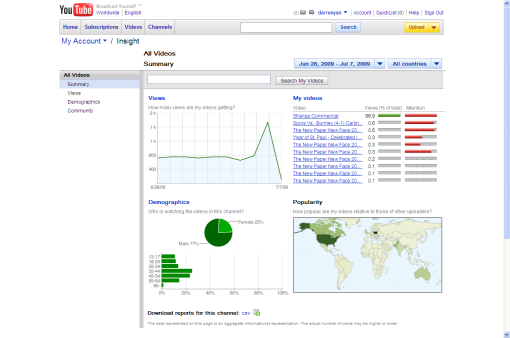
While the Internet is clearly an alternative channel to distribute advertisers’ video messages, it is perhaps more important for the advertiser to appreciate the advantages the Internet offers over the television medium. The most obvious advantage is the scientific measurement of the number of online users who viewed the video advertisement. Unlike the television medium (specifically viewers receiving free-to-air channels on non-cable boxes) that tracks viewing on random sample of panelists, the online medium gives advertisers metrics such as the date, time and viewer’s geographical location (based on the user’s IP address). These tools are readily available on Youtube to measure the effective distribution of the uploaded video.
The commercial solutions offered by portals offer a more sophisticated array of online tools for advertisers. For example, AsiaOne’s Targeted Video Commercial service allows the advertiser to select the segment within the portal to distribute the video advertisement. This allows the advertisement to be targeted to a specific target audience who will presumably appreciate the video’s subject matter and context. Moreover, advertisers will know the percentage of all users who finished viewing the entire video advertisement. Finally, advertisers can maintain a consistent brand positioning by customizing the design of the panel (or what is commonly known as the skin of the video player) that broadcast the video advertisement.
At this point, it seems that the advertiser has an economic solution to distribute their video advertisements that sufficiently meets their objectives of maximizing reach. However, I would argue that advertisers should now consider the influence of social media as the next evolution of online video advertisement, or what I term it as video advertisement 2.0. In an earlier posting, I put forth the argument that social media is now a mainstream medium which is embraced by millions around the world. As such, it is perhaps fitting to integrate the elements of social media into the production of the video advertisement so as to take advantage of this medium.
What does this really mean? The advantage of social media lies in the power to influence or instigate the viral effect of a message (which includes advertising). Accordingly, the creative development of a video advertisement 2.0 should involve piquing the interest of the target audience, rather than communicating a direct message. This is an evolutionary change, which will probably deter some advertisers as it risk missing the opportunity to deliver the supposed message to the target audience. Yet, I would argue that the online user of today is perhaps more discerning then before and is usually sceptical at any advertising message that interrupts their online experience. As such, the challenge to advertisers and creative agencies is to develop a video advertisement that really sets the people talking. This “talking” is expressed through the many online forums today, none more evident than on social media sites such as Facebook and Friendster, as well as blogs written by anyone who have Internet access. This is the viral effect which, if harnessed properly, will have a positive multiplier effect on the level of awareness associated with the advertiser. More importantly, individuals with a strong social network have inadvertently become the advertiser’s ambassador by extending the distribution of the video advertisement to their network. As such, the collective viral effect would have generated the word-of-mouth effect which translates into higher reach for the same video advertisement.
Hence, it can be concluded that the viral effect of video advertisement 2.0 will require a rethink on the creative process leading up to the video production. Thankfully, we have some progressive advertisers that worked with agencies that share this belief in incorporating social media in video advertising. One of the best examples is the T-Mobile UK’s Life’s About Sharing campaign.
Filmed in Liverpool, it triggered a tremendous viral effect on the Internet that led to the development of a second video advertisement being produced.
Samsung has dabbled into this field by coming up with the Extreme LED sheep advertisement that promotes the technology that drives its LED television products.
The advertisement generated more than 8 million views on Youtube and generated more than 150,000 postings on the Internet on the same keywords used on the video site.
Finally, there’s the Evian Babies commercial which generated more than 6 million web entries. Herein is another example of producing videos which trigger responses online.
As always, the power of the Internet allows advertisers to measure the social influence of the video advertisement that incorporates social media. A case study of this measurement methodology is offered by Visible Measures which tracked the viral effect of the Nike commercial below.
In this example, the company tracks engagement, viral distribution and re-production into parodies on the same Nike advertisement. These measures form the justification on extending the reach of the video advertisement with 2.0 tools and social media strategies.
It is perhaps fitting that I end this posting with an example closer to home. Here’s one of the many MobileOne advertisements which has created a parody on Youtube
M1 Commercial
Parody of M1 Commercial
Hence, the Internet is an alternative video advertisement channel, and the economics is definitely more compelling than television. What is recommended, however, is for advertisers to take advantage of the social media element in their video production process. A carefully thought out advertisement will achieve a multiplier effect to extend the reach of the advertiser. As the start of this posting suggest, it is the objective of the advertiser to maximize reach, and this is certainly one way to do so.
– Darren –

 Digital Media Journal